
An offsite isn't a meeting with a view.
An executive offsite takes your leadership team out of the building to do the work the building won't allow — candid conversation, real alignment, and decisions that hold. Some people call it a leadership retreat; the words matter less than the design.
A change of scenery alone does nothing. What separates an offsite that sticks from one that fades is simple: every hour serves one outcome you defined before anyone booked a flight.
Start with the function, never the format.
Before you choose a venue or an activity, answer two questions: What do you want your people walking away feeling, thinking, and saying to one another? And: if this offsite achieved only one thing, what would it be? Those answers are the function. Everything else — place, format, agenda — is just a tool to serve it.
The single thing that has to be true when everyone goes home.
Who's in the room, how long, budget, mobility, season.
Pick the environment that serves the outcome — not the one that photographs best.
Tension, experience, debrief, decisions — in an order that builds.
Measure the change against a baseline so it's real, not a memory.
Want the deeper checklist? Read 12 questions to ask before any executive offsite and the two questions that define a great offsite.
A sample three-day offsite agenda.
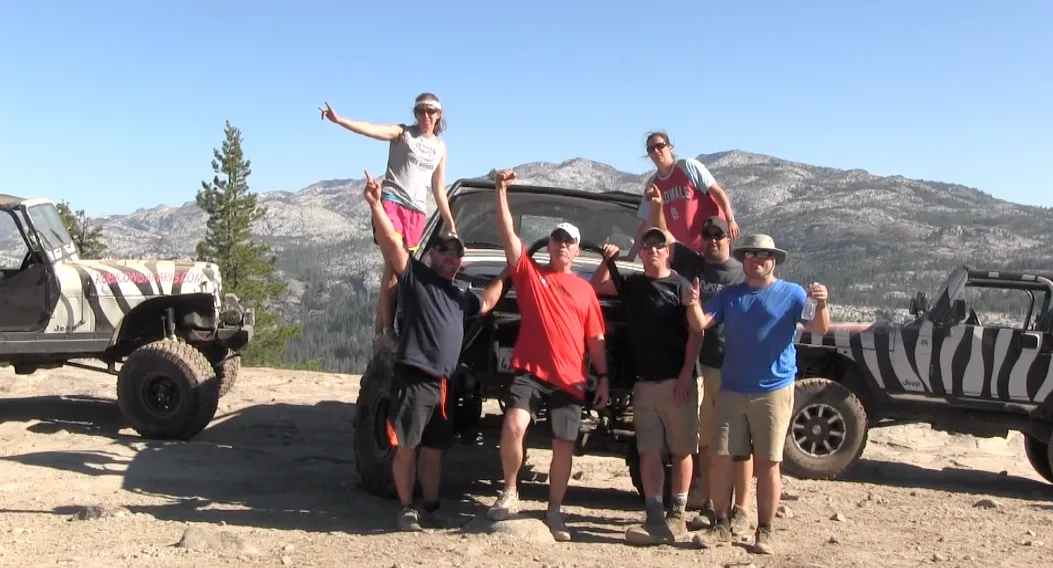
Illustrative only — we design every agenda around your outcome. This is one real shape: a three-day off-road immersion built to rebuild trust and decision-making under pressure. (Prefer the water? The same arc runs as a three-day sailing offsite.)
- Morning — Arrival, framing of the two days, and the one outcome the team is here to reach. Safety and the basics of the terrain.
- Midday — Onto the trail. Real obstacles that demand a spotter, a driver, and total trust — the org chart disappears.
- Afternoon — A team challenge that can only be solved together; the way they solve it mirrors how they work.
- Evening — Camp or lodge, dinner, and the nightly debrief: What went right? What could we do better? Where does this show up at work? What will we do differently tomorrow?
- Morning — A shared, unfamiliar skill — learned together — that resets who leads and who follows.
- Midday — The longest stretch of trail and the day's central challenge, tied directly to the outcome.
- Afternoon — A moment of legacy and perspective (a landmark, a place, a story) that pulls the team out of the quarter and into the bigger picture.
- Evening — Dinner somewhere memorable, and the debrief that turns the day's experience into commitments.
- Morning — Convert insight into decisions: who owns what, what changes, what stops.
- Midday — Each person leaves with a personal action plan and the team with a shared one.
- After the offsite — 30 days of daily prompts, tracking, and a day-30 report measured against the baseline — so the change is real, not a nice memory of a trip.
The format should follow your outcome. A few starting points: an on-the-water sailing offsite, an off-road or winter-survival immersion and the rest of our Signature formats, or a destination chosen for the work — see where we run offsites and retreats. Not sure which fits? That's the conversation.
Very little, in practice — two words for taking a leadership team out of the building to do work the building won't allow. "Offsite" tends to imply a shorter, more work-focused session; "retreat," something longer and more immersive. What matters is the design: built around one defined outcome and reinforced afterward. See the full offsite vs. retreat comparison.
One full day is enough for a single, focused outcome — a decision, a reset, an alignment. Two to three days is right when the work is deeper: rebuilding trust, integrating a new or merged team, or setting a new direction.
Six to twelve weeks is typical for a focused offsite. Plan further ahead for peak seasons, premium venues, or a fully bespoke multi-day retreat.
Use an outside facilitator whenever the CEO needs to be a participant rather than the referee — which is most of the time. A neutral facilitator asks the questions an insider can't and keeps every hour pointed at the outcome. More on executive offsite facilitation.
Ready-to-run Signature offsites run roughly $35,000–$100,000 per retreat; fully bespoke, turnkey retreats run $75,000–$500,000+. See what drives the cost.