
Nothing to distract. Nowhere to hide.
From the field 178% gain in teaming behaviors at 30 days for five rival executives at an online auto retailer, after two days stranded together on the western side of Lippincott Pass, inside the park. Read the case study →There's a clarity to extreme landscapes. With no comfort to retreat into and a horizon that goes on forever, a team's noise falls away and the real conversation rises to the surface. Death Valley's scale resets perspective: problems that felt enormous in the office look different from the floor of the lowest place on the continent.
We pair it with off-road routes through Titus Canyon and beyond: narrow, dramatic and remote. The place is a means, not the product. If Death Valley serves your outcome, we run it; if somewhere gentler serves it better, we will tell you.
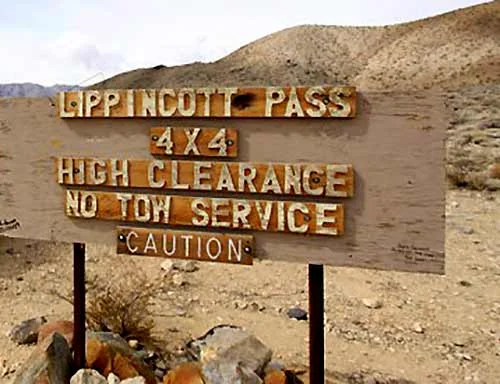
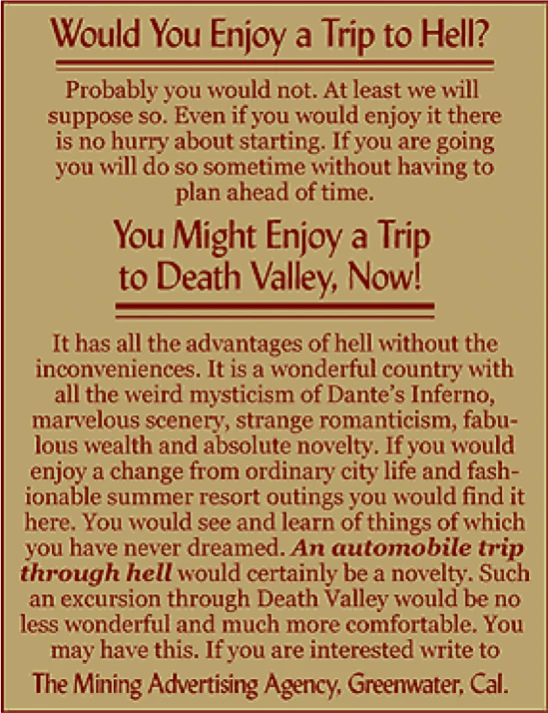
Lippincott Pass, and an actual 1907 advertisement. Death Valley has always tested who shows up.
An elemental landscape that quiets the noise and sharpens what matters.
The scale of the place puts a team's problems in proportion.
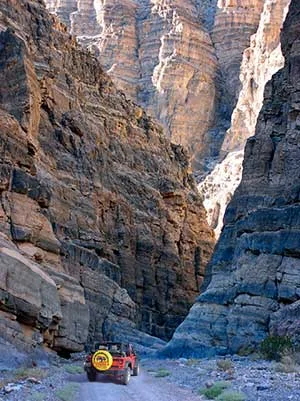
Slot-canyon routes and backcountry few will ever experience.
Canyons, a pass, the salt flats and the dark.
The park is bigger than some states. We use a handful of places, each chosen because of what it does to a team, with guided vehicles, water planning and a satellite link throughout.
A one-way dirt road that drops from the Nevada side through a narrow canyon to the valley floor. High-clearance vehicles, walls closing in, and no way to turn back: a good metaphor for a team that has been circling a decision.
A steep, rough 4x4 route toward the Racetrack, signed for high-clearance vehicles only. The kind of terrain where a team has to communicate or stop moving. It is where our auto retailer team spent two days stranded together.
282 feet below sea level, the lowest point in North America. Salt flats to the horizon and a natural setting for the “where are we really?” conversation.
The park is a Gold Tier International Dark Sky Park, the highest rating. Even at Furnace Creek, with the resort’s own lighting, the sky rates Bortle Class 2; a short drive out it gets darker still. An evening session under that sky changes the tone of what people are willing to say.
The practical details.
When to go
November to March only. Summer is among the hottest on Earth and not suitable for a retreat.
Getting there
Las Vegas (LAS) is about 120 miles, roughly 2 to 2.5 hours by road to Furnace Creek. Los Angeles is about 4.5 hours.
How long
Two to three days. The landscape does its work fast.
Where you stay
We use the historic Furnace Creek Inn (now The Inn at Death Valley), opened in 1927, so the hard day ends with comfort and a long table.
A sample three-day shape
A starting point. Every retreat is built around your one outcome.
Day 1
Arrive
Drive in from Las Vegas, sunset over the salt flats, and the framing conversation over dinner.
Day 2
Into the canyons
An off-road day through Titus Canyon and beyond, with time in the silence built in.
Day 3
Decide
A morning session to turn the clarity into decisions, then back to Las Vegas.
What it costs
Every retreat here follows our three tiers: Focused $35,000–$50,000, Signature $45,000–$150,000 and Bespoke $75,000 and up, turnkey and exclusive of air travel. What moves the number here: peak winter-season lodging, vehicles and guiding for canyon routes, and transfers from Las Vegas. See what an executive retreat costs and the three tiers.
Straight answers
When can you run a retreat in Death Valley?
November to March. Summer heat makes the park unsuitable for a retreat.
How do we get to Death Valley?
Fly into Las Vegas; Furnace Creek is about two to two and a half hours by road.
Is it safe?
In the right season and with guided vehicles, water planning and a satellite link, yes. We never run it in summer.
Why Death Valley rather than a resort?
Its silence and scale strip away noise. For some outcomes that clarity is the whole point; for others we will recommend somewhere gentler.
Can you run a retreat in Death Valley for a leadership team of 8 to 12?
Yes. Retreats in Death Valley are private and designed for leadership teams of roughly 5 to 12. Where you stay: the historic Furnace Creek Inn inside the park, so the hard day ends with comfort and a long table. Larger groups are possible with a different format; we will tell you honestly what changes.
What is included in a retreat in Death Valley?
Design, facilitation by James Carter, lodging, meals, activities, on-site coordination and ground transfers, plus a 30-day challenge with a written day-30 report. Airfare is the usual exclusion. Focused and Signature retreats come with a written proposal within 72 hours.
How far is Death Valley from Las Vegas?
About 120 miles to Furnace Creek, roughly two to two and a half hours by road. Los Angeles is about 275 miles, around four and a half hours. Most teams fly into Las Vegas.
Is Death Valley right for a team in conflict?
Often, yes. Shared difficulty in a place with no distractions is what pulls a split team together. Our online auto retailer retreat put five rival executives on the western side of Lippincott Pass for two days; teaming behaviors were up 178% at 30 days.
Where do you stay on a Death Valley retreat?
We use the historic Furnace Creek Inn, now called The Inn at Death Valley, which opened in 1927. The hard day in the canyons ends with a hot shower, a good meal and a long table.
Can we combine Death Valley with Las Vegas?
Yes. Many teams fly into Las Vegas, and a one-day Las Vegas team day can open or close the trip before the drive into the park.
Who a retreat in Death Valley is for
Private retreats for CEOs and leadership teams of roughly 5 to 12, built around one outcome. We are strongest with teams that need to work as one: teams in conflict, split into camps, or newly merged. Every retreat is turnkey, and Focused and Signature retreats come with a written proposal within 72 hours.
Formats that run here
Nearby destinations
Flying through Las Vegas with only a day? See the Las Vegas team day. Or see every destination, including Costa Rica, Alaska and AlUla.